
How to Hire the Right Freelance Developer for Your Project

15 min read • Sep 7, 2026
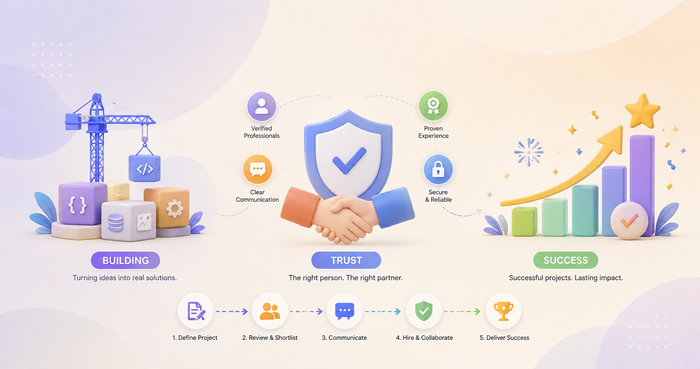
Hiring a freelance software developer can give you access to specialized expertise without building a full-time development team.
But finding a developer is the easy part.
Finding the right developer—someone who understands your idea, has the technical ability to build it, communicates well, and can actually deliver—is much more important.
Whether you’re building an MVP, mobile app, SaaS platform, e-commerce website, internal business system, or adding features to an existing product, a better hiring process can significantly improve the outcome.
This guide covers the most important things to consider when hiring and working with a freelance software developer.
1. Describe What You Need, Not Just the Technology
It’s perfectly fine to mention technologies you already use or prefer. If you have an existing product built with React and Node.js, for example, that information is obviously important.
But a technology stack alone doesn’t give developers enough information to understand or estimate your project.
Instead of focusing primarily on technologies, explain what the product needs to do, who will use it, and the key workflows involved.
For example, instead of:
We need a React and Node.js booking platform with user accounts, payments, and an admin dashboard.
provide more context:
We need a booking platform where customers can search for service providers, check availability, make appointments, and pay online. Providers should be able to manage their schedules and bookings, while our team needs an admin dashboard to manage users and transactions. We currently prefer React and Node.js, but we’re open to technical recommendations.
The second description gives developers much more useful information.
It helps them understand the actual product, identify potential technical challenges, and provide a more realistic proposal.
A useful project description should usually explain:
- What you want to build
- Who will use it
- The main problem it solves
- The most important features
- Whether you already have designs or specifications
- Whether you’re extending an existing product
- Any important third-party integrations
- Your approximate timeline
- Your expected budget
You don’t need to have every detail figured out before talking to a developer.
A good developer can help turn an initial idea into a more concrete technical plan.
2. Define the Scope Before Comparing Prices
One of the biggest challenges in software development is comparing proposals for work that hasn’t been clearly defined.
Imagine one developer estimates a project at $5,000 while another estimates $15,000.
That doesn’t necessarily mean the second developer is expensive.
They may be estimating completely different amounts of work.
One proposal might cover only the core application, while another includes:
- UI implementation
- Backend development
- Database design
- Authentication
- Payment integration
- Admin tools
- Testing
- Production deployment
- App Store or Google Play submission
- Post-launch support
There may also be significant differences in how developers interpret requirements such as “admin dashboard,” “payment system,” or “real-time messaging.”
Before comparing prices, make sure you understand what each proposal actually includes.
The clearer the scope, the more meaningful the estimates become.
3. Look Beyond the Skill List
Technical skills matter, but don’t evaluate a developer simply by counting technologies on their profile.
A developer listing 30 technologies isn’t automatically more suitable than someone listing 10.
Look for experience that resembles your project.
If you’re building a marketplace, previous experience with marketplaces, payments, messaging, search, and user management may matter more than knowing another programming language.
If you’re building a mobile application, look for relevant iOS, Android, Flutter, or React Native experience.
If you’re building a SaaS product, experience with authentication, subscriptions, APIs, databases, cloud infrastructure, and production deployment can be particularly valuable.
The important question isn’t:
“How many technologies does this developer know?”
It’s:
“Has this developer solved problems similar to mine?”
4. Use the Portfolio to Understand Real Experience
A portfolio can tell you much more than whether a developer can create attractive interfaces.
Look at what was actually built.
For each relevant project, try to understand:
- What kind of product was it?
- What problem did it solve?
- What was the developer responsible for?
- Which technologies were used?
- Did they build the frontend, backend, mobile app, or entire system?
- Did the project involve integrations such as payments, maps, messaging, AI, or cloud services?
- Was the product actually launched?
Pay particular attention to projects that share characteristics with your own.
For example, if you need a mobile marketplace with subscriptions and real-time messaging, a developer who has already built products involving those systems may have encountered many of the technical challenges your project will face.
That experience can be more valuable than a long list of unrelated skills.
5. Pay Attention to How Developers Think
The best proposal isn’t necessarily the longest one.
Look for signs that the developer actually understands your project.
A strong candidate may:
- Identify unclear requirements
- Ask relevant questions
- Mention potential technical challenges
- Suggest a simpler implementation
- Point out risks you haven’t considered
- Explain how they would approach the project
Suppose you’re building a booking platform.
An experienced developer might ask what should happen when two customers attempt to book the same time slot at nearly the same moment.
Or they might ask whether cancellations immediately return availability, whether providers can block time manually, and how different time zones should be handled.
Those questions are useful signals.
They show that the developer is thinking beyond the visible interface and considering how the system will actually work.
Good developers don’t only implement requirements.
They help turn requirements into workable software.
6. Don’t Automatically Choose the Lowest Bid
Price matters, especially when you’re working with a limited budget.
But software development isn’t a commodity where every developer produces the same result.
A cheaper proposal can become significantly more expensive if the project needs to be rebuilt later.
When comparing developers, consider the complete picture:
Relevant Experience + Technical Ability + Communication + Reliability + Price
Sometimes the lowest-priced developer genuinely is the best option.
In other cases, paying more for someone with directly relevant experience can reduce development time and project risk.
The goal isn’t to hire the cheapest developer.
It’s to get the best outcome for your budget.
7. Start With Clear Milestones
Large software projects are easier to manage when they’re divided into smaller deliverables.
For example, instead of treating an entire application as one large delivery, development might be organized into milestones such as:
- Architecture and project setup
- Authentication and user accounts
- Core application features
- Payments and third-party integrations
- Admin functionality
- Testing and bug fixing
- Production deployment
The exact structure depends on the project.
A mobile application, for example, might have separate milestones for design implementation, backend integration, beta testing, and App Store submission.
The important thing is that both sides understand what each milestone represents.
Clear milestones make progress easier to evaluate and reduce uncertainty about what should be delivered next.
8. Establish Communication Expectations Early
Good communication doesn’t mean having meetings every day.
It means both sides understand what is happening.
Before development begins, agree on how you’ll communicate and how often you expect updates.
For many projects, a simple structure works well:
Completed → In Progress → Next → Blockers
For example:
User registration and login are complete. I’m currently implementing the booking flow. Payment integration is next. I need confirmation on the cancellation rules before completing that section.
A short update like this gives you a clear picture of the project’s status without requiring unnecessary meetings.
It also makes problems visible earlier.
If something is blocked, delayed, or unclear, you want to know before it becomes a larger issue.
9. Give Developers Enough Context
Clients sometimes provide individual tasks without explaining the larger goal.
That can work for straightforward changes, but context often helps developers make better decisions.
Instead of saying:
Add another button here.
you might explain:
Users are having difficulty finding the checkout process, so we’d like to make the next action more obvious.
The developer now understands the problem rather than simply the requested implementation.
They might agree that another button is the right solution.
Or they might notice that changing the existing layout would solve the problem more effectively.
This is particularly valuable when you’re working with experienced developers.
You’re not only hiring someone to write code. You’re also gaining access to their experience solving similar product and technical problems.
10. Expect Requirements to Change
Most software projects change during development.
You may discover that users need something different. A technical limitation may appear. A third-party service may behave differently than expected. Or you may simply have a better idea after seeing the product working.
This is normal.
The important thing is to distinguish between:
Clarifying the original requirement
and
Adding new scope.
For example, changing the wording on a checkout screen is very different from deciding halfway through development that the application also needs a subscription system.
When significant new functionality is introduced, discuss how it affects the timeline and budget before development continues.
Clear communication around scope changes prevents many client–freelancer disagreements.
11. Test Throughout the Project
Don’t wait until the final day to look at the software.
Whenever possible, review working versions throughout development.
Test important workflows yourself.
If you’re building an e-commerce application, for example, try the complete customer journey:
Sign Up → Find Product → Add to Cart → Pay → Receive Confirmation → Manage Order
If you’re building a marketplace:
Create Account → Create Profile → Search → Contact → Purchase or Book → Complete Transaction
Testing real workflows often reveals issues that aren’t obvious when reviewing individual screens.
Regular feedback also gives the developer confidence that the project is moving in the right direction.
And when misunderstandings happen, they’re usually much cheaper to fix early.
12. Think Beyond the Initial Launch
Launching the software isn’t necessarily the end of the project.
Production software may require:
- Bug fixes
- Server maintenance
- Security updates
- Performance improvements
- Dependency upgrades
- New operating system support
- New features
- Analytics
- Infrastructure changes
- Improvements based on user feedback
Before the project finishes, understand what happens afterward.
Who will maintain the application?
Who has access to the source code and infrastructure?
Where are the production credentials stored?
Is documentation required?
Will the developer provide support after launch?
These questions are particularly important for business-critical applications.
If you’ve found a reliable developer who already understands your product, maintaining that relationship can be extremely valuable.
13. Build a Relationship, Not Just a Transaction
A successful freelance project can become the beginning of a long-term working relationship.
Once a developer understands your product, architecture, users, and business requirements, future development often becomes much more efficient.
You don’t need to explain everything from the beginning each time.
A reliable developer may eventually help with:
- New features
- Product improvements
- Technical decisions
- Infrastructure
- Performance optimization
- Maintenance
- Mobile applications
- Integrations
- Future products
This doesn’t mean every freelancer needs to become a long-term partner.
But when you find someone who consistently delivers good work and communicates well, that relationship has value.
Hiring well once can make future development significantly easier.
Building Successful Projects on Seeek
Seeek helps clients connect with software development professionals across web, mobile, backend, cloud, AI, and other technical disciplines.
But successful software projects depend on more than matching a list of requirements with a list of skills.
Start with a clear explanation of what you’re trying to build.
Look for developers with relevant experience. Review their previous work. Pay attention to the questions they ask and how they think about your requirements. Compare proposals based on scope and value—not price alone.
Once development begins, use clear milestones, communicate regularly, review working software, and address changes before they become problems.
The objective isn’t simply to hire a freelancer.
It’s to find the right person to help you turn an idea into software that works.